Project Background

Project Requirements: Under NAU’s Biomechatronics Lab, my team and I designed an orthotic exoskeleton for the lab's patient tester, who has cerebral palsy. This project focused on creating an orthotic device to reduce hand adduction while assisting flexion and extension of the hand and fingers. Additionally, the orthotic needed to keep the hand open to combat muscle tone resulting in severe hand and finger flexion.

Product Ideation: Generating customer requirements was the first thing the team did. Before beginning brainstorming or generating engineering requirements, we performed a state of the field analysis alongside a literature review. Most on-market solutions were expensive and bulky, which was also shared by most research solutions. Comparing engineering requirements from the researched solutions to our customer needs helped the team generate quality engineering requirements. This process guided the team to look at non-powered solutions since powered solutions would be impractical in day-to-day use. The decided-upon design was an exoskeleton that would be attached to a fabric interior.

Prototyping: Additive manufacturing was vital to the prototyping process. Since parts could be 3D printed within a day of design, we could test, apply changes, and reprint within a week. I oversaw 12 prototype generations in 3 months because of this loop. Furthermore, when we reworked the gear system from the ground up manufacturing wasn't delayed.

Challanges: Opting for a mechanically actuated solution as opposed to a powered one proved to be the biggest encountered challenge because we had generated additional force without motors. There were similar projects in the literature, so the gear system created to transform arm extension into hand flexion was a new approach. Creating a force-limited clutch allowed the device to have the variable force and a reset mechanism.

Personal Contributions: I designed the finger supports, as well as the hand and wrist support system. I also assisted with the clutch and forearm attachment. Otherwise, I oversaw rapid prototyping, device testing (and test creation), engineering analysis, design validation, part procurement, and the team budget. I used SolidWorks for part design and documentation, using ABET guidelines.

Project Details

Device Description (Description limited due to NDA):
The orthotic device used rigid parts to keep the Patient Tester's hand open when needed and reduce hand and finger adduction. However, its soft body still allowed for movement elsewhere. Force was transmitted from arm extension into hand and finger flexion. Once a certain amount of force was reached the hand and clutch would reset, allowing the process to repeat.

CAD:
SolidWorks’s GearTrax was used to create gears that could then be modified as needed. Equations made sure roller clutch adjustments were timely and guaranteed the angle of grip would always be such that the bearings would not bounce out and cause a slip. Tables and equations were used for all parts for speed of adjustment.

Design For Manufacturing:
Each part was designed to be 3D printed. I validated finished parts to ensure they would be optimal for 3D printing.

Design:
The design of each part was influenced by the engineering requirements as derived from the customer needs and state of the field analysis. These rigid body parts would be attached to a soft sleeve and cable system. This system is lightweight and breathable, ideal for daily use.
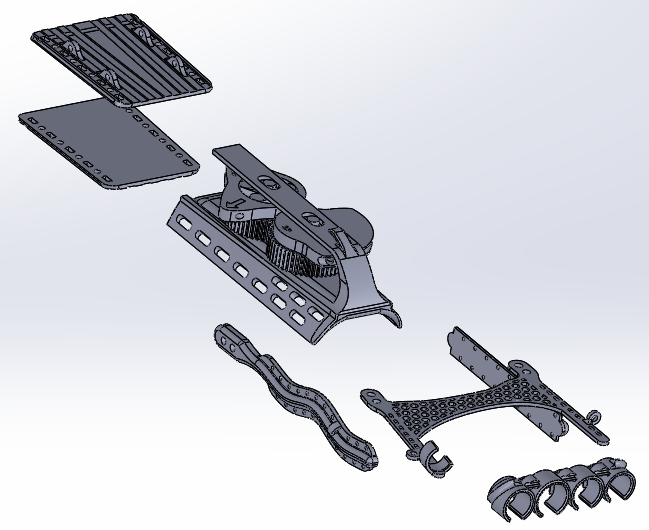
Orthotic Exoskeleton Exploded View

Exploded View of Exoskeliton.